Honour Roll
An unknown man from HMAS Sydney
Not all of HMAS Sydney's 645 men went down with the ship and were lost.
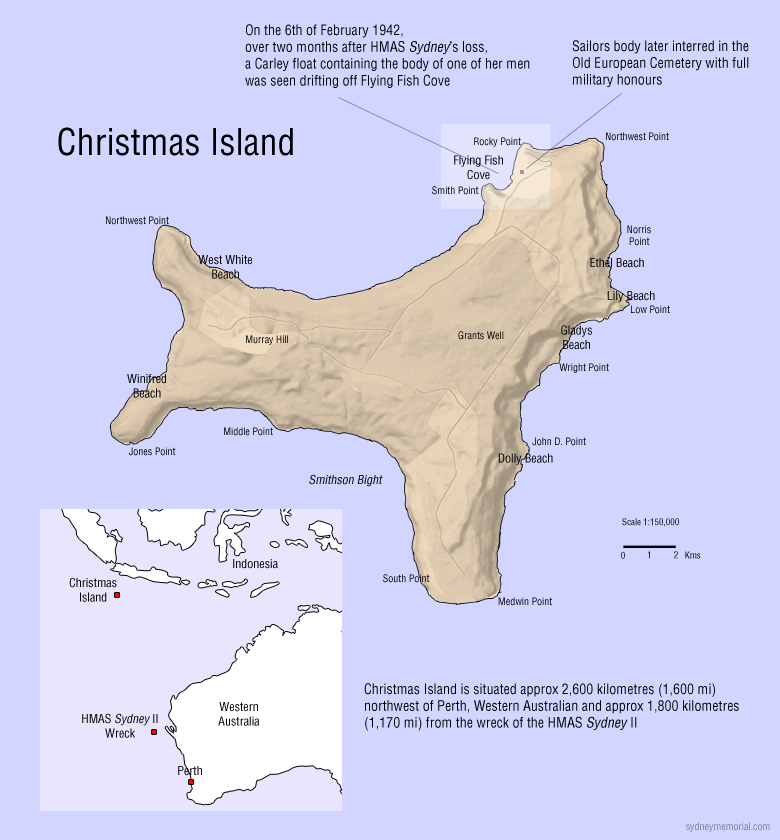
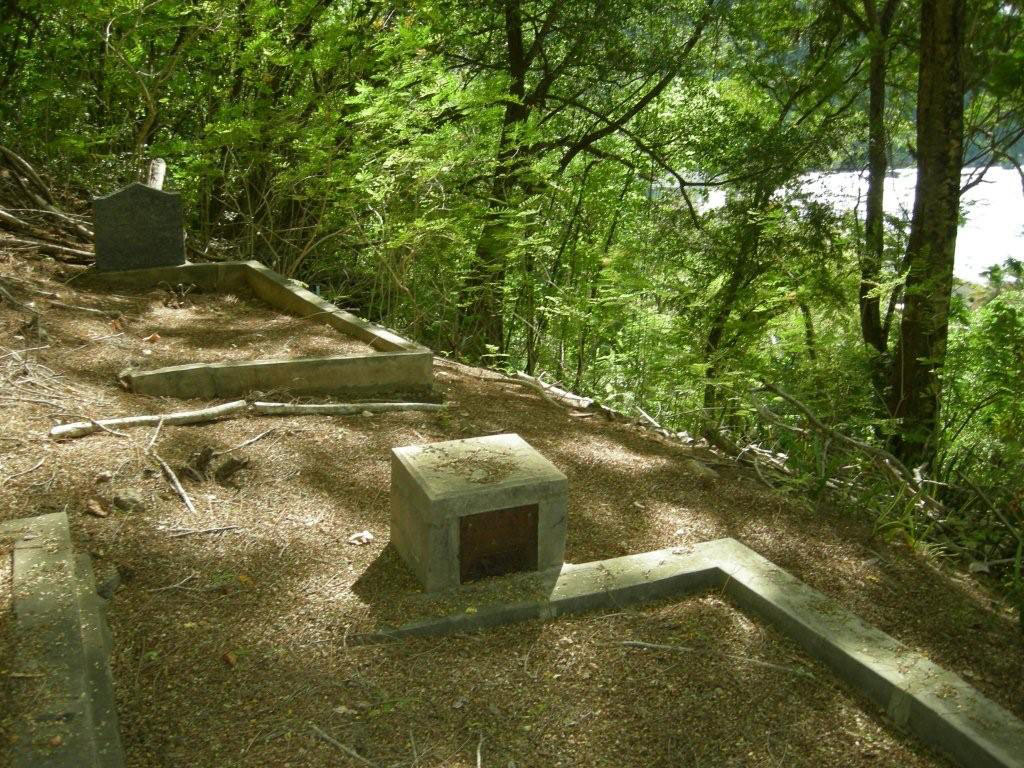
On , over two months after HMAS Sydney's loss, a Carley float containing the body of one of her men was seen drifting off Flying Fish Cove, Christmas Island; the float was recovered and the body later interred in the Old European Cemetery with full military honours. Some weeks later the Island was occupied by the Japanese for the duration of the war. The grave was never more than a mound of earth that gradually disappeared under material washed down from the escarpment above and any means of identifying the man, including the exact location of his grave, was lost until successfully investigated more than sixty years later.
Nevertheless this unknown man, the only member of her Ship's Company to be found, became the anchor for honouring the memory of all of the brave men who laid down their lives in HMAS Sydney's last battle.
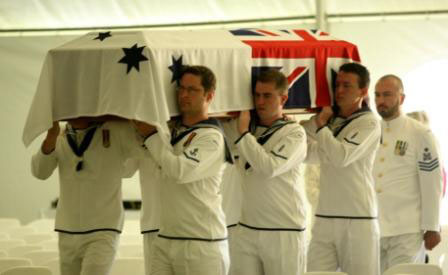
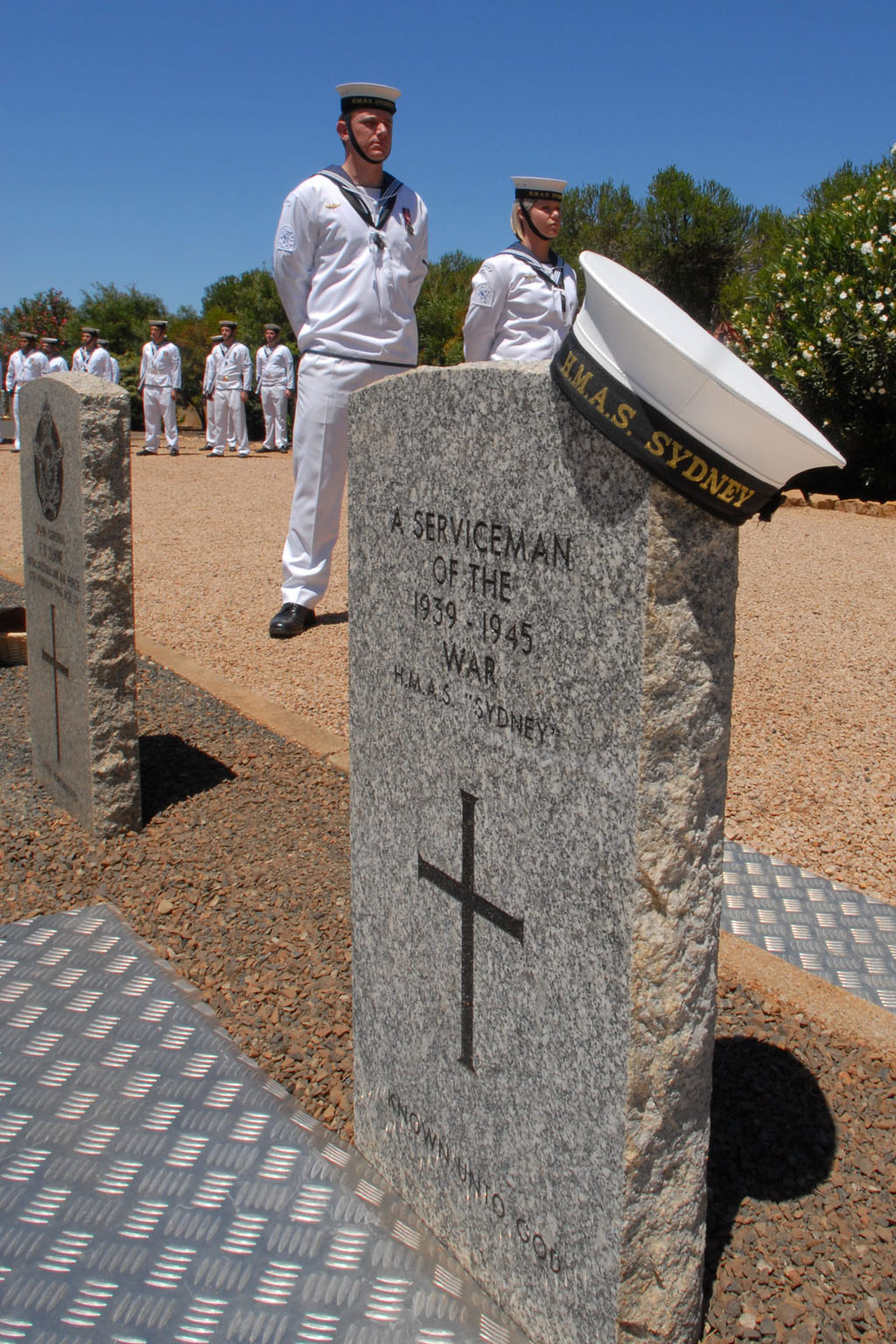
After many years searching, the grave site on Christmas Island was found in and the body was exhumed and examined but, at the time, not identified. The records of some 300 men went down with the ship. The man was re-interred with full military honours on at the Geraldton War Cemetery, Western Australia.
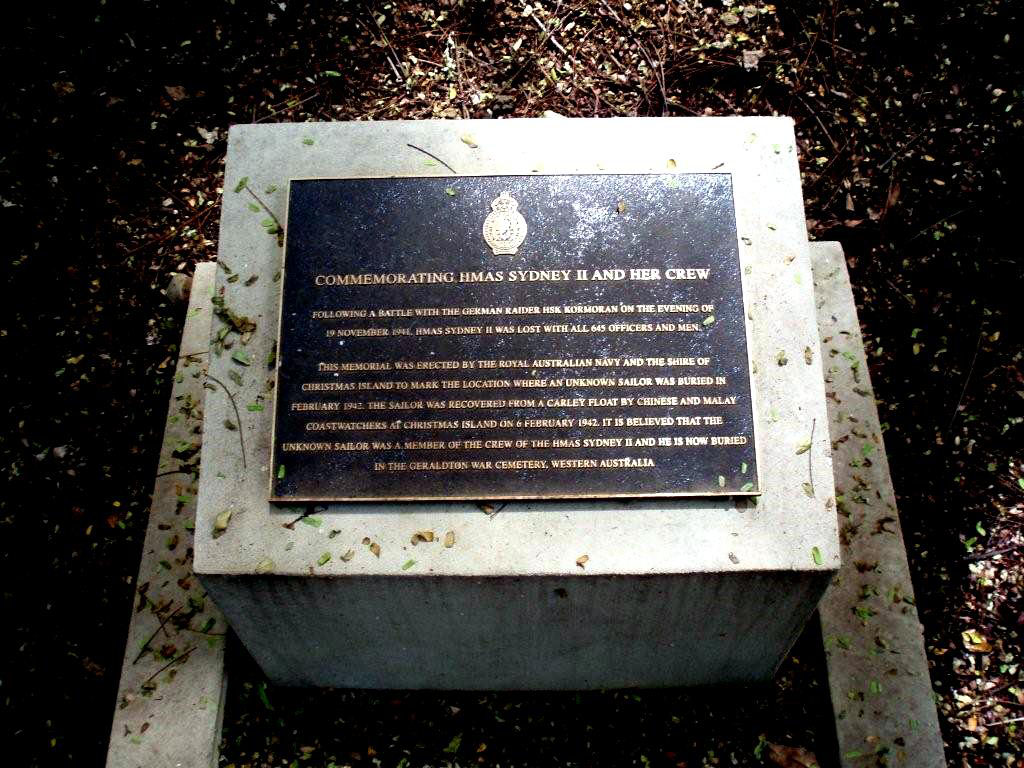
The Unknown Sailor continues to serve his country by enshrining a nation's love of peace and to remind us that, in the sacrifice of the men whose names are recorded here, there is faith enough for all of us who remain.
We do not know this man's name but hope that one day we will.
We do not know his rank or what his duties were.
We do not know for certain whether he was a sailor, airman or civilian.
We do not know where he was born, or precisely how and when he died.
We do not know where he had made his home or when he left it for the Service.
We do not know his age or his circumstances; whether he was from the city or the bush; what occupation he left to serve his country; what religion, if he had a religion; if he was married or single.
We do not know who loved him or whom he loved; if he had children or which of us they are; but we do know that his family is one shown on this Memorial so he is not lost to us as he was lost to them.
He may have believed that War would be an adventure too grand to miss or he may have joined up because he believed it was the duty he owed to his family, his country and his King.
We know that he sailed in HMAS Sydney, tasting triumph and disaster as one of 645 Shipmates who died in her battle with HSK Kormoran on . Unknown, he is all of them and he is one of us.
This Unknown Sailor did not die in vain for his sacrifice reminds us that these were not just ordinary men but the heroes of that war; who taught us to endure hardship, to show courage, to be bold and resilient, to believe in ourselves, to stick together.
That is surely at the heart of the Sydney story and the Australian legend which emerged from all wars. It is a legend not of sweeping naval victories so much as triumphs against the odds, of courage and ingenuity in adversity. It is a legend of free and independent spirits whose discipline derived less from military formalities and customs than from the bonds of mateship and the demands of necessity. It is a democratic tradition that makes us Australians.
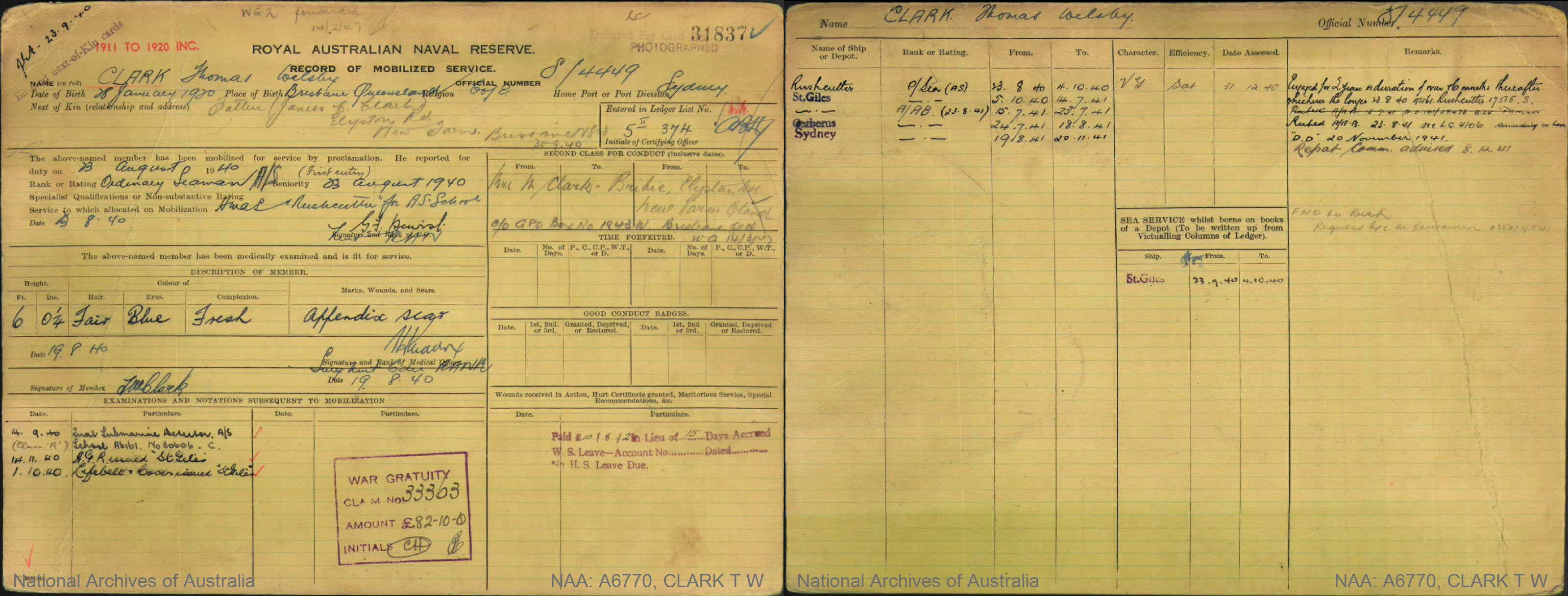
Thomas Welsby Clark
Copyright of the Sea Power Centre - Australia, and reproduced here with their permission.
In the years since a committed team of researchers continued working hard to identify the unknown sailor, and in DNA testing was to reveal his identity beyond doubt.
On , at a special ceremony held at the Australian War Memorial marking the 80th anniversary of Sydney’s sinking, the Chief of Navy, Vice Admiral Mike Noonan, AO, RAN, announced that it was Able Seaman Thomas Welsby Clark who had finally completed his long voyage home.
Thomas Welsby Clark was born in the Brisbane suburb of New Farm, Queensland on ; the third son of James Colin Clark and Marion Clark (née Welsby). His father was a grazier who was the eldest son of James Clark, an orphan, who, as the result of hard work and wise business investments in the pearling industry, had risen from abject poverty to become one of the richest men in Queensland. Thomas’ mother descended from Scottish immigrants who had arrived in Victoria in the early .
Thomas was educated at Slade School in Warwick, Queensland but also spent time working on the family properties and their Brisbane oyster leases. He was an excellent swimmer and a keen yachtsman. Upon leaving school he became an accountant in Brisbane, and on enlisted in the Militia (Army Reserve) as a private in the Queensland Cameron Highlanders. He was discharged from the Militia on in order to join the Royal Australian Navy. His elder brothers, Arthur and James, served in the Army and Air Force respectively.
Thomas Clark joined the Royal Australian Naval Reserve on and was posted to the anti-submarine training school, HMAS Rushcutter in Sydney, where he completed training as a Submarine Detector. On completion of his training he served as an Ordinary Seaman in the anti-submarine training ship HMAS St Giles, based in Sydney Harbour. Thomas was promoted Acting Able Seaman on before completing a short period of training at HMAS Cerberus, the RAN’s premier training depot in Victoria, during -.
On completion of that training he joined the light cruiser HMAS Sydney (II) in . At that time Sydney was tasked with conducting patrol and escort work on the Australia station, escorting such famous troopships as the Queen Mary and Queen Elizabeth in southern Australian waters throughout . In the cruiser began operating off the Western Australian coast, escorting convoys from Fremantle to the Sunda Strait in the Netherlands East Indies. There Sydney would hand the convoy over to other Allied warships that would then continue escorting the ships to Singapore.
%20for%20web.jpg)
On Sydney departed Fremantle escorting the troopship Zealandia, carrying troops of the 8th Division, 2nd Australian Imperial Force. On , in the vicinity of Sunda Strait, Sydney handed the troopship escort over to the cruiser HMS Durban before commencing the return voyage to Fremantle.
On the afternoon of Sydney sighted a merchant ship some 200 kilometres west of Shark Bay, Western Australia, and closed to investigate. Sydney signaled the ship to identify itself, continuing to close the mysterious vessel as she did so. The merchant ship stated it was the Dutch steamer Straat Malakka, but in fact she was the disguised and heavily armed German merchant raider Kormoran, which had already sunk ten unsuspecting merchant ships in the Indian Ocean and taken another as a prize.
Sydney drew closer, rescinding her advantage of superior gunnery and range, demanding that the ship identify itself with its allotted secret call sign. The captain of the German raider, Theodor Detmers, did not have the response, and with Sydney close on his starboard beam he ordered the immediate hoisting of the German battle ensign and opened fire. In the battle that followed both ships were mortally damaged. Sydney, torpedoed and ablaze, later sank with the loss of all 645 members of her ship’s company. The crew of Kormoran abandoned ship before the raider was scuttled, using demolition charges that set off her cargo of more than 300 sea mines. Approximately three quarters of her crew survived to become prisoners of war.
When Sydney failed to return to Fremantle a major search for the ship began; but only a single empty life-raft, known as a Carley Float (now on display at the Australian War Memorial) and an inflated RAN lifejacket were found.
Several months later on another badly damaged Carley Float containing the body of a naval rating wearing blue overalls was washed up at Christmas Island in the Indian Ocean. The body was recovered, and with no means of identifying the individual his remains were buried in an unmarked grave in the European cemetery there.
In the post-war years speculation that the body came from HMAS Sydney (II) increased, leading to a number of official inquiries being held that were to confirm the assumption. Efforts to relocate the body, with a view to attempting to identify it, followed and in the remains of the unknown sailor were exhumed by a specialist ADF team. The remains were carefully examined and biometric data and DNA samples were recorded before the sailor was reinterred, with full Naval Honours, in the Commonwealth War Graves Commission cemetery in Geraldton, Western Australia - the closest war cemetery to where Sydney was lost.
Lest We Forget.