History: The Final Battle
An Enduring Mystery
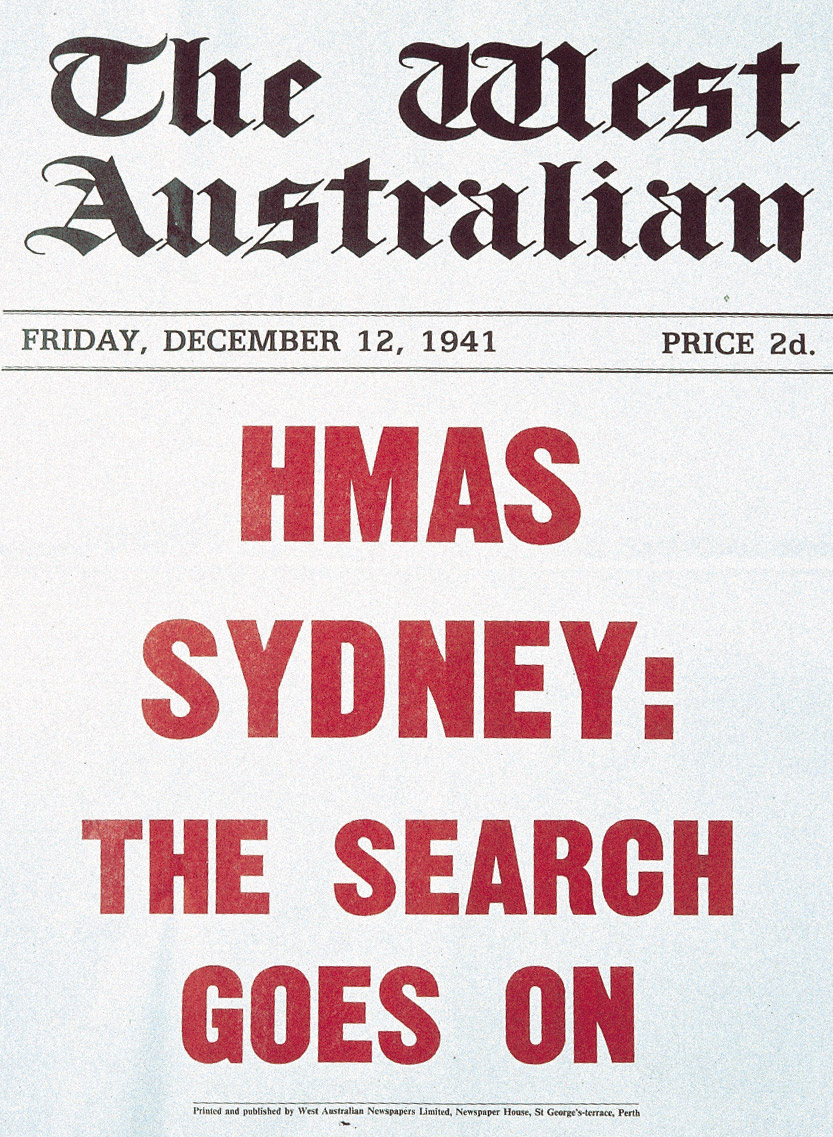
Sydney sailed from Fremantle on Armistice Day, to escort the troopship Zealandia to Sunda Strait where she was to be relieved by the British cruiser HMS Durban for the last leg of the voyage to Singapore . The voyage was without incident and at , Zealandia was turned over to Durban and Sydney then proceeded back to Fremantle where she was expected to arrive on the . She did not arrive as expected and the District Naval Officer, Western Australia , reported accordingly to the Naval Board at the following day that Sydney was overdue. This did not immediately concern the Naval Board as they had been advised that Zealandia had arrived later than anticipated and it was assumed that Sydney too had been delayed. There was also the possibility that she might have been diverted for another purpose and had not broken radio silence. When however, she had not returned by , she was instructed by the Naval Board to report by signal. There was no reply.
Account of the final battle
Returning from her convoy duties to Java, Sydney was proceeding south along the north west coast of Western Australia when she sighted what appeared to be a merchant vessel at about on , some 130 miles west of Shark Bay.
The ship was in fact the German raider Kormoran, (Commander Theodor Detmers) disguised as the Dutch merchantman Straat Malakka . Sydney challenged the vessel continuously using her searchlight whilst at the same time closing the range between the two ships. Merchant vessels were known to be less efficient at visual signalling and the Germans exploited this knowledge through their actions on their flag deck and by their slow response to Sydney's challenges. Eventually the mystery vessel hoisted the signal letters PKQI identifying herself as the Straat Malakka . At , to further the deception, Kormoran broadcast a 'suspicious ship' message, feigning a cry for help in the name of Straat Malakka .
Sydney's efforts to establish the true identity of the vessel resulted in her closing the range to a point where she no longer had the advantage of her superior armament. At approximately Sydney had drawn almost abeam of Koromoran to starboard, less than a mile distant. Both ships were steering West-South-West at about 15 knots. The Australian cruiser was at action stations with all guns and torpedo tubes bearing. Her aircraft was on the catapult with its engine running. She then signalled, both by flags and flashing light; 'Where bound?' Kormoran replied ' Batavia '. The crucial moment then came when Sydney hoisted a two flag signal consisting of the letters 'IK' which the raider could not interpret. They were in fact the two centre letters of the Straat Malakka's four letter secret identification signal. With no reply forthcoming Sydney signalled in plain language 'Show your secret sign'.
Finally, when concealment of his vessel's true identity was no longer possible, and with the advantage of surprise, Detmers ordered the Dutch colours to be struck, hoisted the German Naval Ensign and opened fire at approximately with all armament at a range 'somewhat more than a mile'.
It is likely that the raider's first salvo destroyed Sydney's bridge, with the result that her primary control was immediately put out of action. Sydney's own guns opened fire almost simultaneously with a full salvo that passed over Kormoran without inflicting damage. Kormoran again scored hits on Sydney with two salvos again hitting her bridge and midships section. According to the Germans all of Kormoran's armament was brought to bear on Sydney , concentrating on her bridge, torpedo tubes and anti aircraft batteries.
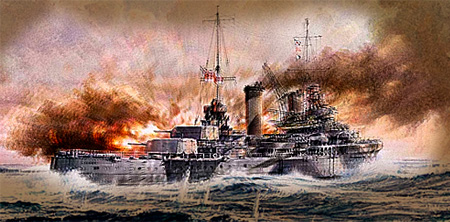
For a few seconds after her initial salvo Sydney did not reply. It appears that her forward "A" and "B" turrets were put out of action leaving only her after turrets "X" and "Y" to respond. It was reported by the Germans that Sydney's "X" turret opened fast and accurate fire, hitting Kormoran in the funnel and engine room. " Y" turret is said to have fired only two or three salvos, all of which went over. At about this time one of the raider's two torpedoes struck Sydney under "A" and "B" turrets. The other passed close ahead of the stricken ship, which was subjected to enfilading fire.
With her stem low in the water, Sydney now turned sharply towards Kormoran as though attempting to ram. As she did so, the top of "B" turret was blown off and flew overboard, the cruiser then passed under Kormoran's stern, heading to the southward and losing way. Kormoran , maintaining her course and speed, was now on fire in the engine room where hits by Sydney's "X" turret had caused severe damage. Smoke from the fire hid Sydney from Kormoran's bridge but the raider continued to engage with her after guns as the range opened to approximately 4,400 yards.
At about . Sydney fired four torpedoes. Detmers was then turning to port to bring his broadside to bear, however as he did so Kormoran's engines began to fail. The torpedo tracks were sighted, but Kormoran cleared them and they passed astern. Simultaneously the raider's engines broke down completely.
Sydney , crippled and on fire from the bridge to the after funnel, steamed slowly to the south returning only sporadic fire from her secondary armament. Although by now the range had opened to 6,600 yards Sydney continued to receive steady hits from Kormoran's port broadside. At , at a range of 7,700 yards, Kormoran then fired one torpedo that missed Sydney's stern. Although this fierce action had lasted only half an hour both ships had been dealt mortal blows.
Kormoran fired her last shot at at a range of about 11,000 yards. In all, she fired approximately 450 rounds from her main armament and hundreds from her anti-aircraft batteries. With the gathering gloom the form of Sydney disappeared from view and was last seen by the Germans about ten miles off, heading approximately South-South-East. Thereafter, until about , all that was seen was a distant glare then occasional flickerings until at, which time all trace of, Sydney disappeared.
Of Sydney's total complement of 42 officers and 603 ratings, none survived. The only material evidence recovered from Sydney was an Australian naval type Carley life-float recovered eight days after the action by HMAS Heros and an Australian naval pattern life-belt recovered by HMAS Wyrallah. The Carley float is now preserved in the Australian War Memorial in Canberra.
Kormoran Survivors
Sydney Remembered
The loss of HMAS Sydney in with all hands came as a tremendous blow to the Royal Australian Navy and the entire Australian community during a particularly dark period of World War II. Her achievements and proud fighting record are perpetuated in the warships named Sydney that have followed her and on memorials and cenotaphs throughout Australia.
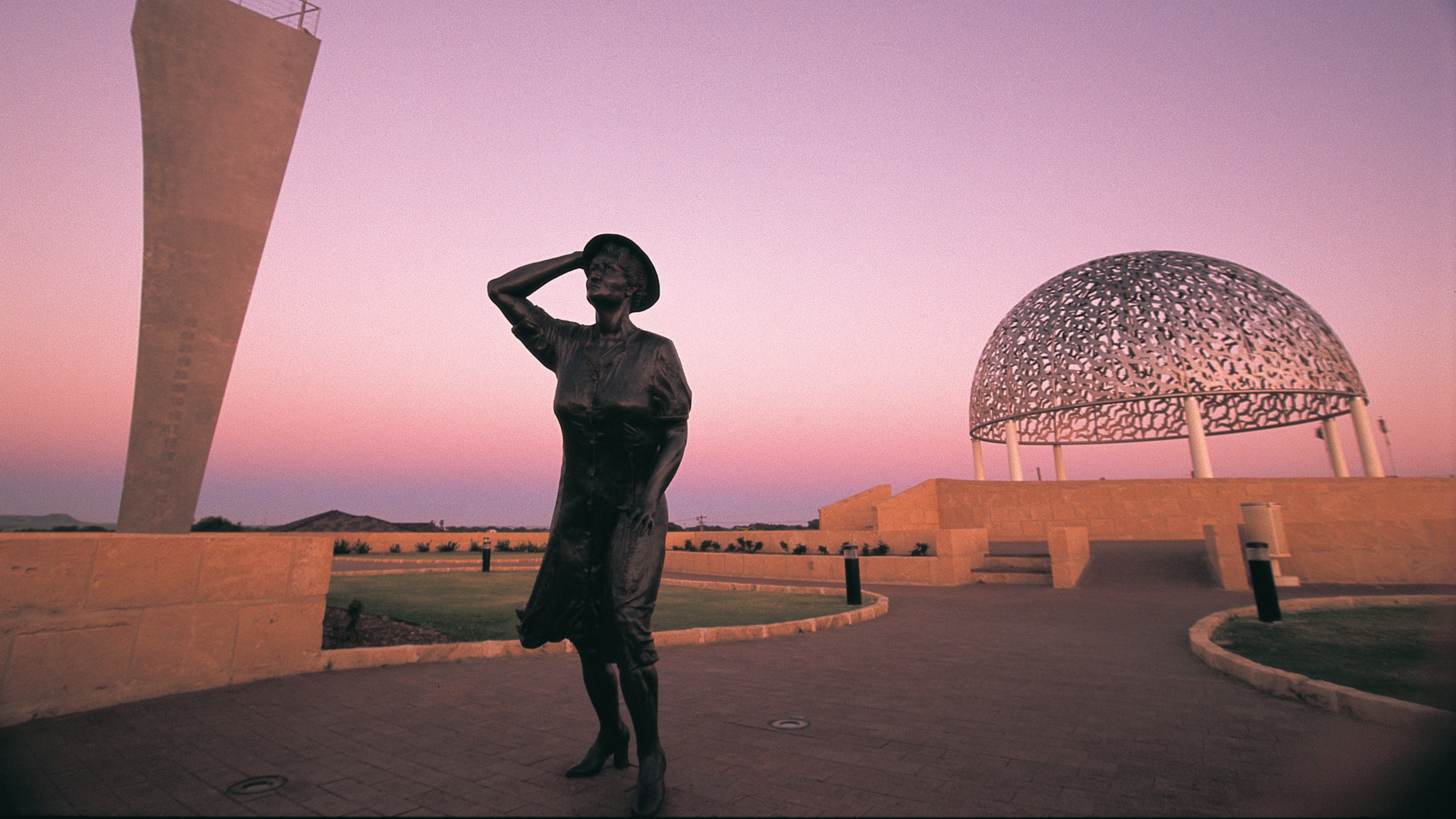
Memorials to HMAS Sydney are located in Geraldton WA, Carnarvon WA and Sydney Harbour NSW.
Additional Information
Additional information on the Sydney - Kormoran engagement can be found at the following links:
- The loss of HMAS Sydney (II) | Royal Australian Navy
- Information relating to the HMAS Sydney (II) and HSK Kormoran engagement of .
- Completed Inquiry: The loss of HMAS Sydney – Parliament of Australia
- Link to the Report on the loss of HMAS Sydney (II) submitted by the Joint Standing Committee on Foreign Affairs, Defence and Trade to the Senate on and to the House of Representatives on .
- National Archives of Australia
- The National Archives of Australia resource for further research into the loss of HMAS Sydney (II).